Posts

Christmas bird food

Image
WINGIN’ IT   By Kate Crowley I know that the birds are supposed to be protected by their layers of feathers from our winter weather, but when the temps drop into the minus 20’s overnight, I really wonder how any of them survive. They must deal with more than 12 hours of darkness without benefit of external sources of heat, like the wood stove that glows with its warmth in our living room.  But every morning, we are blessed with the movement and antics of our resident birds (all 17 wild turkeys included).  Mike gladly goes out each morning to refill the sunflower feeders and the suet feeders if they need it.  He also spreads a wild bird seed mix on the ground.  The turkeys are watching unseen for this earliest feeding and immediately swoop down from the pine trees or race up the front field in single file to forage as fast as possible on the seeds and grain he has spread for them.  Then they retire to the top railing of our fence where they...

Lycopodiums - forest floor plants

Image
GOING NATURE’S WAY By Kate Crowley It is the first week of November, the leaves are off the trees, but the ground below is as green and lush looking as it was in August. And I still have flowers blooming next to the deck; a weird feeling for lifelong Minnesotans.  I will not complain about the mild temperatures because I know that eventually cold and wintery weather will arrive, but that doesn’t change the feeling of abnormality that this autumn weather creates, especially for those of us who study nature and the complex dance of the seasons.  Besides the green grass, which will eventually fade to brown under a layer of leaves and snow, there is green on the forest floor which will remain throughout the winter months, even as a blanket of white covers it.  I walked through our woods the other day with my friend Cindy and she pointed to some of the plants in this group.  She asked, “What are these? They’re so pretty”.  She was referring to a cluster of P...

Red Tailed Hawks and turkeys - November birding

Image
WINGIN’ IT By Kate Crowley November arrives and with it comes the doldrums of birdwatching.  Yes, there will be birds throughout the winter at our feeders and in the trees, but the excitement of spring and summer is a fading memory.  So, I look inspiration wherever I can find it and today it was while driving to the Twin Cities and counting the red-tail hawks perched on the arched road lights on the sides of I35.  They are big birds and if they are facing towards the car you will see a white breast with a dark band below it.  If they are turned with their backs to you, they appear to be mostly brown.  There must be a lot of rodents in the grassy borders in certain stretches because there can be three or four hawks perched in a half mile. Earlier in the week my daughter and I saw two sitting right beside one another on a light pole; not typical for these solitary hunters.  We assumed they were a pair of siblings or possibly a parent and an offsprin...

Ravens, crows and Halloween

WINGIN’ IT By Kate Crowley Stereotypes.  It happens all the time in our society.  It even happens with birds.  How else can you explain the association of crows and ravens with the evil spirits of Halloween?  Both of these birds belong to the Family Corvidae – my favorite, because of their innate intelligence and social interactions.  Like the fairy tales of the Big Bad Wolf, these glossy black birds have come down through the centuries with stories and beliefs that emphasize one behavior that we humans find revolting and ignores all others. During the Middle Ages and the scourge of the Black Plague, these predators and scavengers found easy pickings among the countless dead who lay exposed in streets or fields.  The same was true for the warriors and soldiers killed in endless wars;  people saw the wolves, crows and ravens feeding on the dead and were (not surprisingly) horrified.  It is not a coincidence that wolves and corvids would be...

Late fall

WINGIN’ IT By Kate Crowley Here it is the first week of October and all our flowers continue to bloom and not a hint of frost in the forecast!  We all enjoy these beautiful autumn days, maybe even more than any others because we know they are numbered.  I’ve noticed in recent days that it’s not only us humans who are basking in this warmth and unusual climatic conditions; but so are the bees. Last week when it was cloudy and moist I was surveying the flower beds and stopped by the maroon colored chrysanthemums.  All over the golden disks in the center of the flower were bumblebees.  They were very lethargic and really didn’t seem able to fly.  I tested one with a stick and it could move its wings, but did not get airborne. These bees very slowly moved from flower to flower probing the nectar tubes.  There was no pollen collecting on their bodies, which is an unintended side effect from their search for nourishment.  They only make small amount...

Fall Fungus

Image
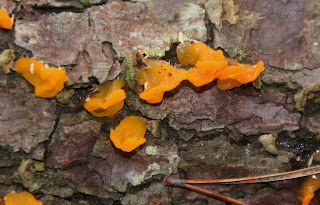
GOING NATURE’S WAY By Kate Crowley If there is a silver lining to be found in this very wet autumn, it is found in the forests.  I’m not talking about the leaves, which are very slowly turning color; I’m referring to the vast assortment of mushrooms on the forest floor and on the sides of some trees.  We just returned from a week’s hiking in the Upper Peninsula of Michigan and I have to say, we have never seen such abundance and variety in the Fungi Kingdom.  The people we were with, I’m happy to report, were just as excited as Mike and I and demonstrated a sense of wonder that adults normally lose.  Overall, I prefer to just observe the variations in shape, size, texture and color of mushrooms.  I do like to eat the types sold in grocery stores and Morels are a favorite in the spring, but I have only eaten a few ‘wild’ mushrooms and that only happened when I absolutely trusted the knowledge of the person I was with.  In Europe people have been...

Great Blue Heron on the Cumberland River

Image
WINGIN’ IT By Kate Crowley We are currently cruising up the Cumberland River, headed to Nashville.  This is all new territory for us and as naturalists we are excited to see new landscapes and rivers.  We call the Cumberland a river, but in this stretch, up from Paducah, it is part of a reservoir system created by the TVA in the 1930s.  Because it is such, there is far less current than we find on the Mississippi River and it is a popular spot for fishing;  For both people and birds. While we were docked in Paducah, on the Ohio, we looked out the window one morning and found ourselves being observed by a Great Blue Heron just a few yards away from us.  It was stalking, as these birds often do, along the very edge of the shore, lifting one impossibly long leg after the other in slow motion.  We could see how the toes flopped down when the foot was raised, and opened as they went back into the water. It tilted its head so its eye could see the wa...